Dark Matter · Early Universe
Primordial Black Holes (PBHs)
Our research utilizes N-body simulations with the GIZMO code and semi-analytical models to investigate PBHs' impact. We find that stellar-mass PBHs (10–100 solar mass), constituting a small fraction of DM, subtly influence the formation of the universe's first stars by maintaining the standard model of star formation, while their accretion feedback shifts star formation to more massive halos. Additionally, PBHs significantly contribute to the cosmic radiation background during reionization, but do not violate existing constraints on the timing of reionization.
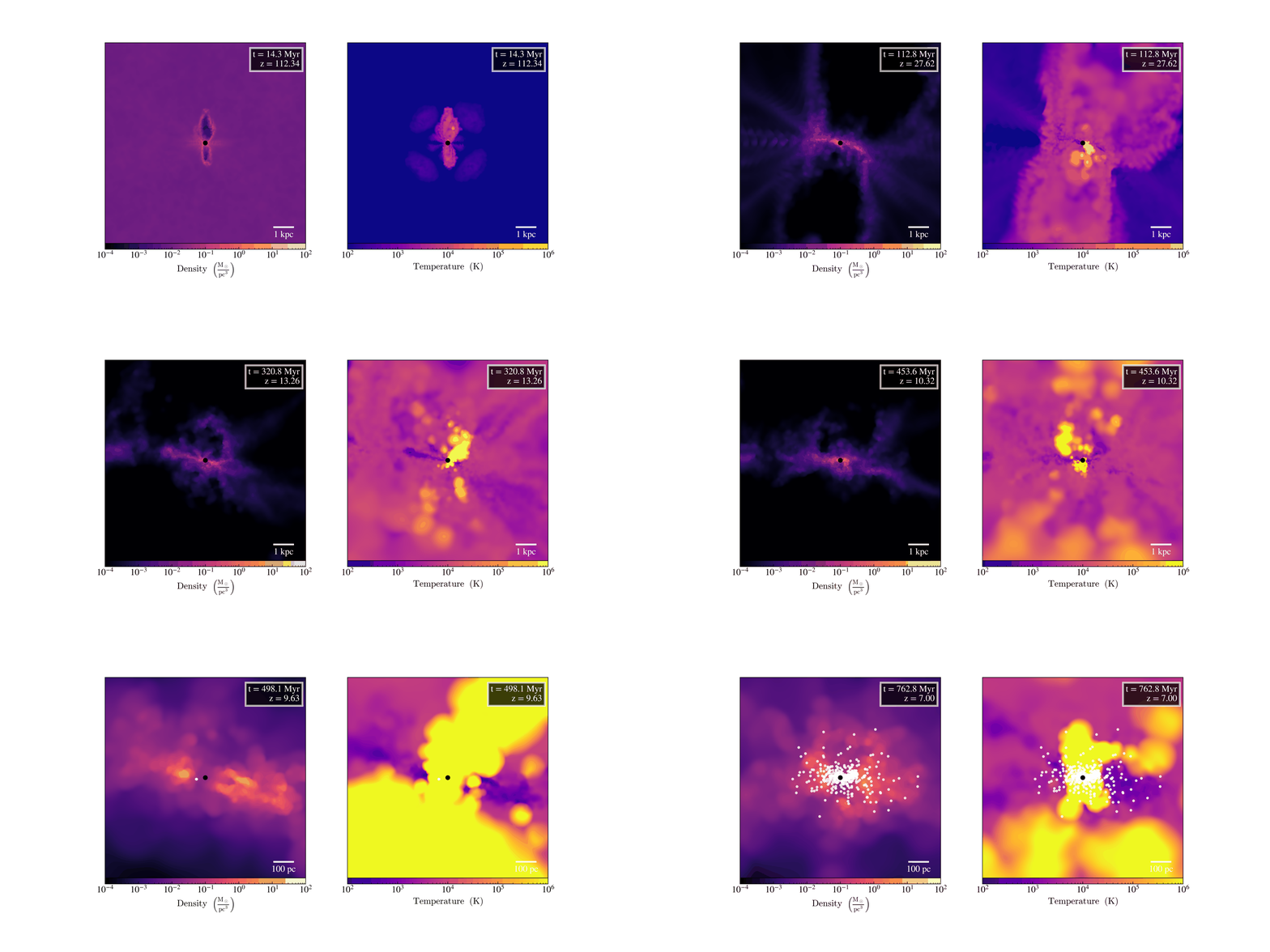
On the other hand, more massive PBHs with a million solar mass could seed massive halos and disrupt hierarchical structure formation by engulfing newly formed halos. In contrast to the effects of stellar-mass PBHs, our recent studies reveal that the narrative of early star formation is complicated by initial perturbations and accretion feedback from these massive PBHs at very high redshifts. Our findings also suggest that PBHs provide a viable explanation for early SMBHs like Abell2744-QSO1.
Future observations with JWST, Roman, and SKA will be critical in distinguishing PBH-driven structure formation from standard Λ-CDM scenarios.
Research Highlights
Related Papers
Zhang, S., Liu, B., Bromm, V., & Kühnel, F. (2025). ApJL. arXiv:2512.14066★ First Author
Juodžbalis, I., ..., Zhang, S., et al. (2025). Submitted to Nature. arXiv:2508.21748
Zhang, S., Liu, B., & Bromm, V. (2025). ApJ, 992(1), 136. arXiv:2508.00774★ First Author
Maiolino, R., ..., Zhang, S., et al. (2025). MNRAS. arXiv:2505.22567
Zhang, S., Liu, B., Bromm, V., Jeon, J., Boylan-Kolchin, M., & Kühnel, F. (2025). ApJ, 987(2), 185. arXiv:2503.17585★ First Author
Übler, H., ..., Zhang, S., et al. (2025). Submitted to A&A. arXiv:2509.21575
Zhang, S., Bromm, V., & Liu, B. (2024). ApJ, 975(1), 139. arXiv:2405.11381★ First Author
Zhang, S., Liu, B., & Bromm, V. (2023). MNRAS, 528, 180. arXiv:2310.01763★ First Author
Liu, B., Zhang, S., & Bromm, V. (2022). MNRAS, 514, 2376. arXiv:2204.06330