Dark Matter
Particle Dark Matter & Pop III Stars
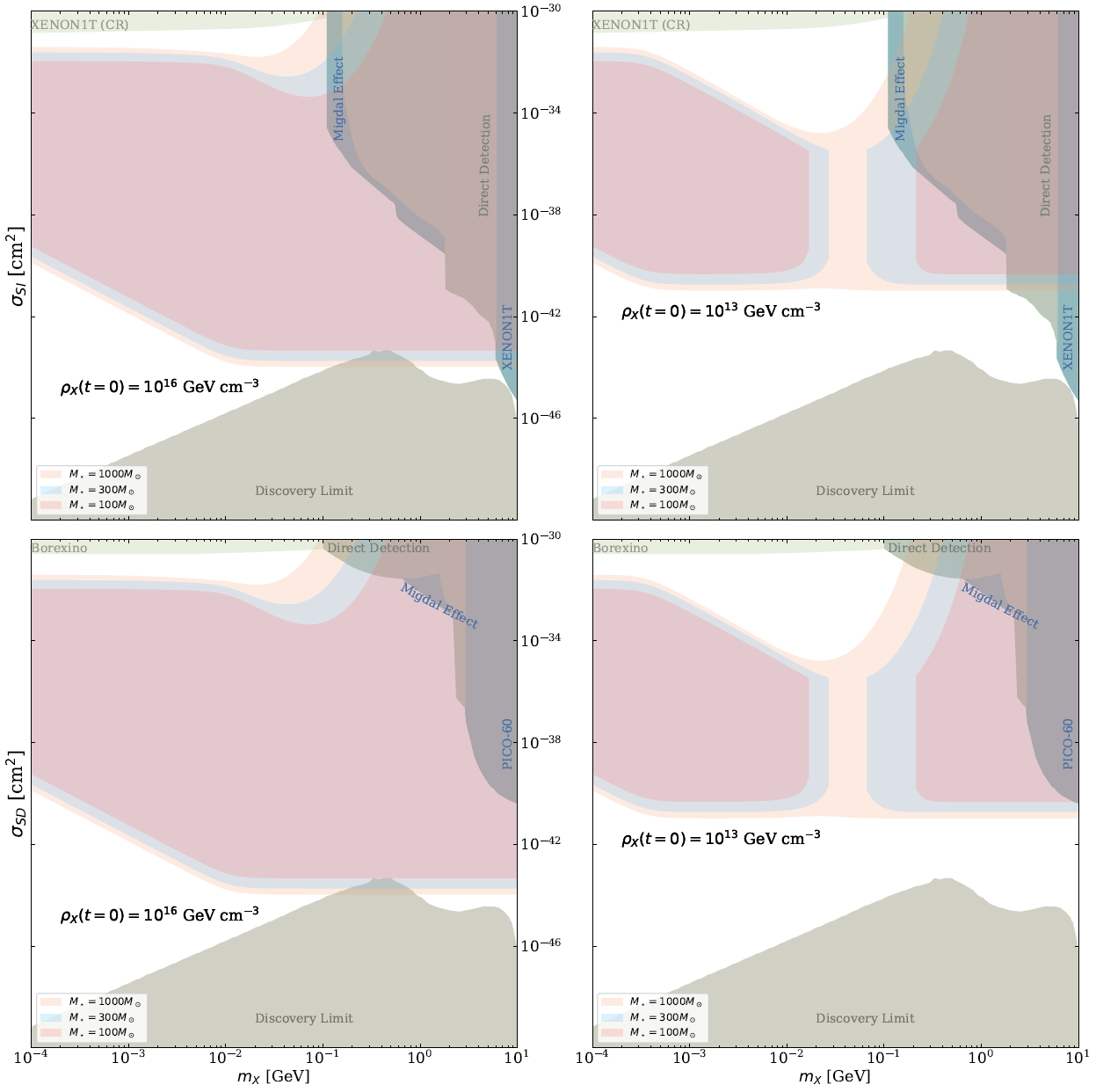
The first generation of stars (Pop III) and compact remnants such as neutron stars offer unique cosmic laboratories for probing the microphysics of particle dark matter (DM), especially in regimes inaccessible to terrestrial experiments. In a series of works, Zhang and collaborators develop a multiscatter capture framework to study how DM particles can be gravitationally captured by stars via repeated interactions, leading to observable consequences such as DM annihilation heating or stellar mass truncation.
Applying this formalism to Pop III stars forming in primordial minihalos at high redshift (z ≳ 15), they show that even current bounds from direct detection experiments like XENON1T imply that dark matter can significantly limit the stellar mass scale. Conversely, observations of massive Pop III stars (≳300 M☉) would constrain DM–nucleon scattering cross sections far below the neutrino floor, especially in spin-dependent channels. The framework is further extended to superheavy DM, where annihilation or energy deposition effects can dramatically alter the early stellar population.
Complementing this, the team explores DM capture in neutron stars, where the extreme densities make even small DM cross sections detectable via stellar heating or collapse signatures. These compact stars, coupled with Pop III progenitors, offer a multi-messenger probe of DM parameter space spanning many orders of magnitude in mass and cross section.
Research Highlights
Related Papers
Ilie, C., Pilawa, J., & Zhang, S. (2020). ArXiv Preprint. arXiv:2009.11478
Ilie, C., Levy, C., Pilawa, J., & Zhang, S. (2021). Phys. Rev. D, 104, 123031. arXiv:2009.11474
Ilie, C., Pilawa, J., & Zhang, S. (2020). Phys. Rev. D, 102, 048301. arXiv:2005.05946
Ilie, C., & Zhang, S. (2019). JCAP, 2019(12), 051. arXiv:1908.02700